

Observing individual animal behaviour in the field using AI
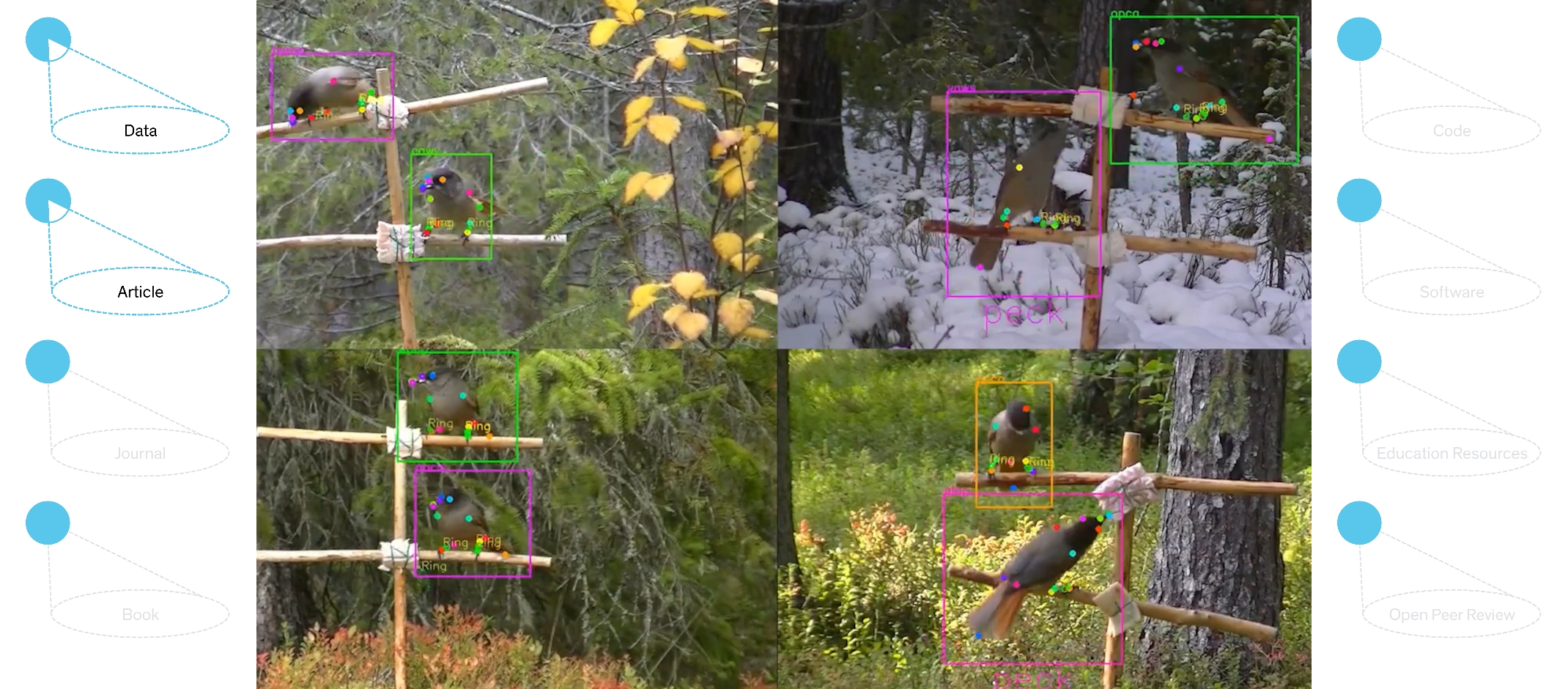
Long-term monitoring of animals identified at the individual level and their behaviour is essential for studying changes over time and drawing meaningful conclusions – for example, in conservation or evolutionary biology. However, manually analyzing data from long-term observations is extremely labour-intensive and time-consuming. Given recent advances in computer vision, delegating this work to artificial intelligence (AI) offers a promising alternative. In practice, this is easier said than done: reliably detecting which individual performed which behaviour within a group of animals requires solving a wide range of computer vision tasks. Until now, suitable datasets integrating all these steps have been lacking.
Based on a long-term study of wild Siberian jays (Perisoreus infaustus) in Swedish Lapland, researchers from Konstanz have introduced CHIRP, an open dataset that addresses this gap by covering all relevant sub-tasks. These include individual identification, behaviour and object detection, keypoint estimation, and instance segmentation. In addition, the team developed a novel method for recognizing bird individuals that is based on the detection of the bird’s colour rings (CORVID) and widely applicable to other bird populations in the wild. In the open-access article on CHRIP and CORVID, the team also proposes a new benchmark for evaluating performance in a task-specific, application-oriented way.
The CHIRP dataset (Combining beHaviors, Individual Re-identification and Postures; DOI: 10.17617/3.GVO4LG) is freely available via the authors’ GitHub repository and on EDMOND.
The accompanying publication on the dataset and the CORVID pipeline (COlouR-based Video re-ID) has been published as an open-access article on the website of the Computer Vision Foundation (CVF).