
Computer science teacher training programme: learning combined with coaching
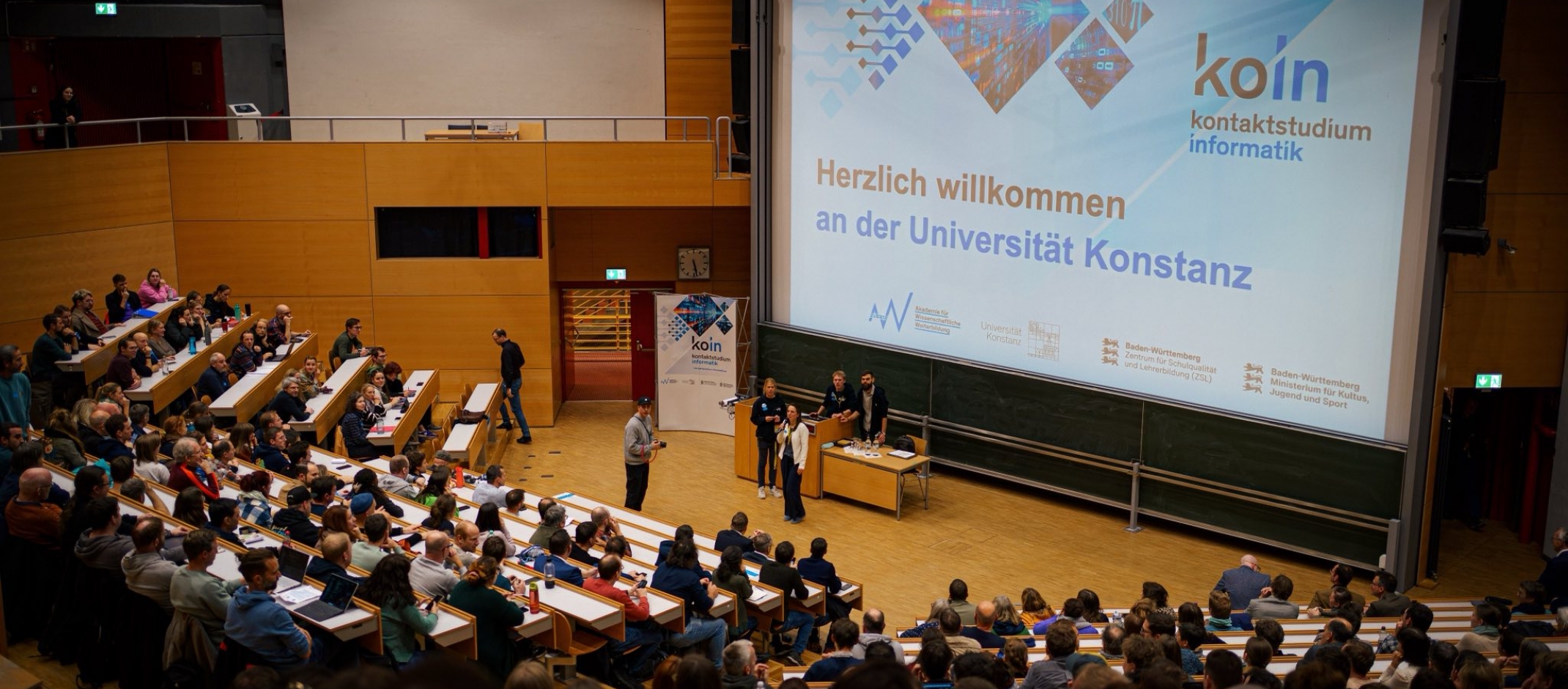
Barbara Pampel, a tenure-track professor for foundations of computer science and computer science education at the university, describes feeling almost a bit overwhelmed at the great interest in the KOIN programme at the kick-off event on 21 and 22 November 2025. "It was then that we truly realized the magnitude of having 400 participants this year!" Along with Michael Grossniklaus, a professor of databases and information systems (also in Konstanz), she is the scientific director of the programme. The two-day event was a very intense experience – not only for participants, but also for the seven-person team of lecturers, the 20 student tutors and programme coordinator Michael Blumenschein.
Starting in 2018, the university's IMP teacher training programme (computer science, mathematics, physics) provided additional qualifications for teaching the computer science portion of the German "Gymnasium"-level profile "IMP", the elective subject of computer science at the "Realschule" level and the subject of computer science at vocational schools. This year, the KOIN programme was introduced and made available to a wider spectrum of teachers. The background for this development is the decision by the Baden-Württemberg state Ministry of Education to start requiring the subject of computer science and media education to be taught at all general education schools in grades 5-11. The resulting number of teaching hours cannot currently be provided by the available amount of computer science teachers with a corresponding degree. The state needs about 2,500 new teachers who will earn the necessary professional qualification bit by bit.
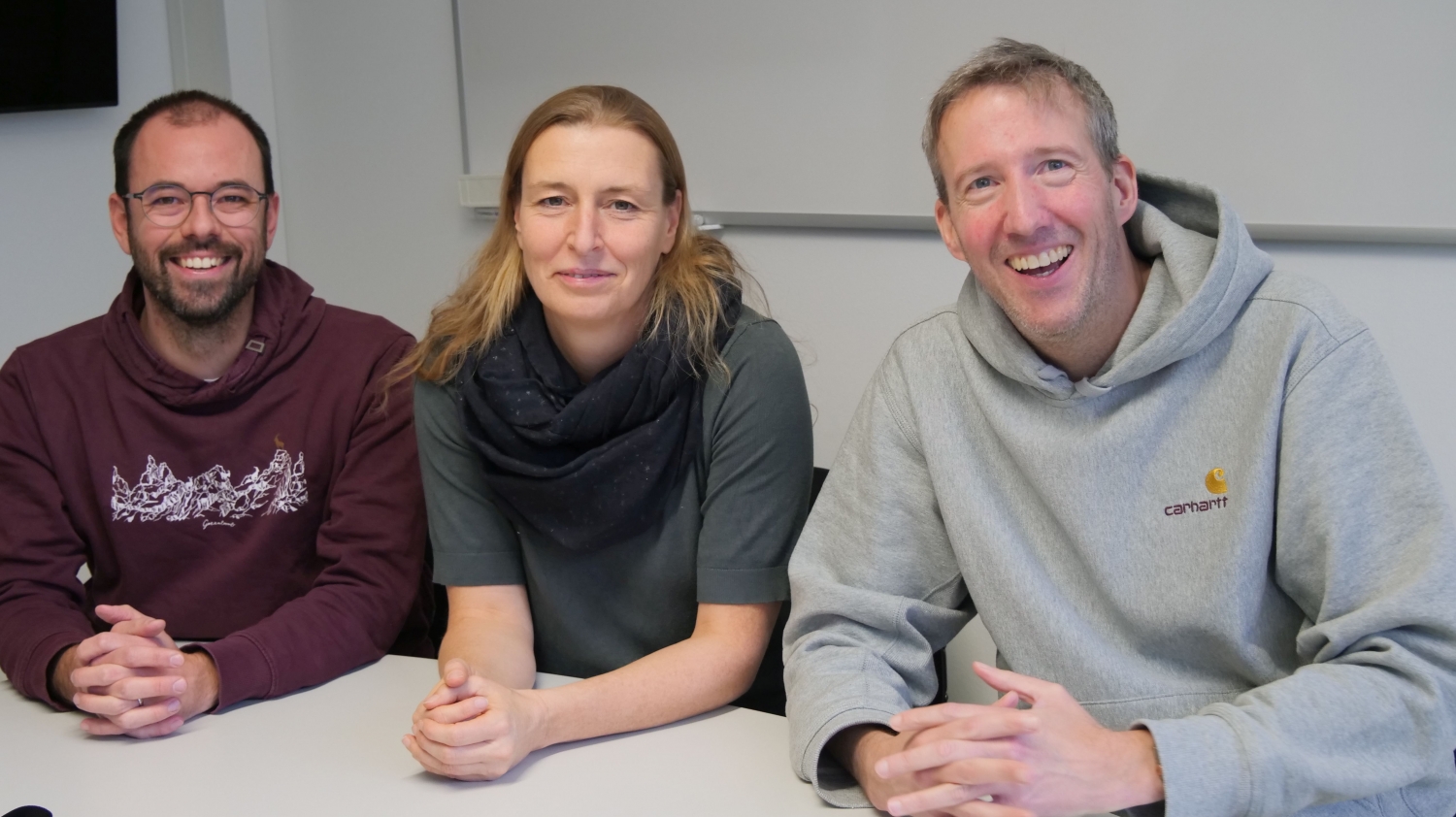
© Claudia Marion VoigtmannMichael Blumenschein, Barbara Pampel, Michael Grossniklaus (from left)
Blended learning for professionals
What is the KOIN programme? It is a one-year subject-specific additional qualification that teachers in Baden-Württemberg can complete alongside their work.
"Based on the number of participants, the Konstanz programme is the largest such measure in Germany. And, even within our broad international network, we have not encountered any programmes that are bigger", Pampel says. "What sets us apart from other formats, is that we provide subject-specific academic training that is pretty comprehensive. At first, there is less of a focus on didactics, since our participants are already teachers and thus have a lot of previous experience in this area."
Barbara Pampel, tenure-track professor for foundations of computer science and computer science education at the University of Konstanz
After passing the final exam, participants are permitted to teach the corresponding subject. Since 2018, this has included more than 1,100 teachers.
How does the KOIN programme work? The programme is offered in the blended learning format, which means that participants learn most of the course content on their own in learning packages tailored to their needs – including everything from lecture recordings to elaborate interactive digital units. Then there are assignments that they complete and get individual feedback on from the student tutors. During a two-day in-person event, participants complete programming courses, with additional ones taking place virtually. There is a new unit to complete each week, except during school vacations. The topics covered range from information coding and basic data structures to the implementation of algorithms and data security.
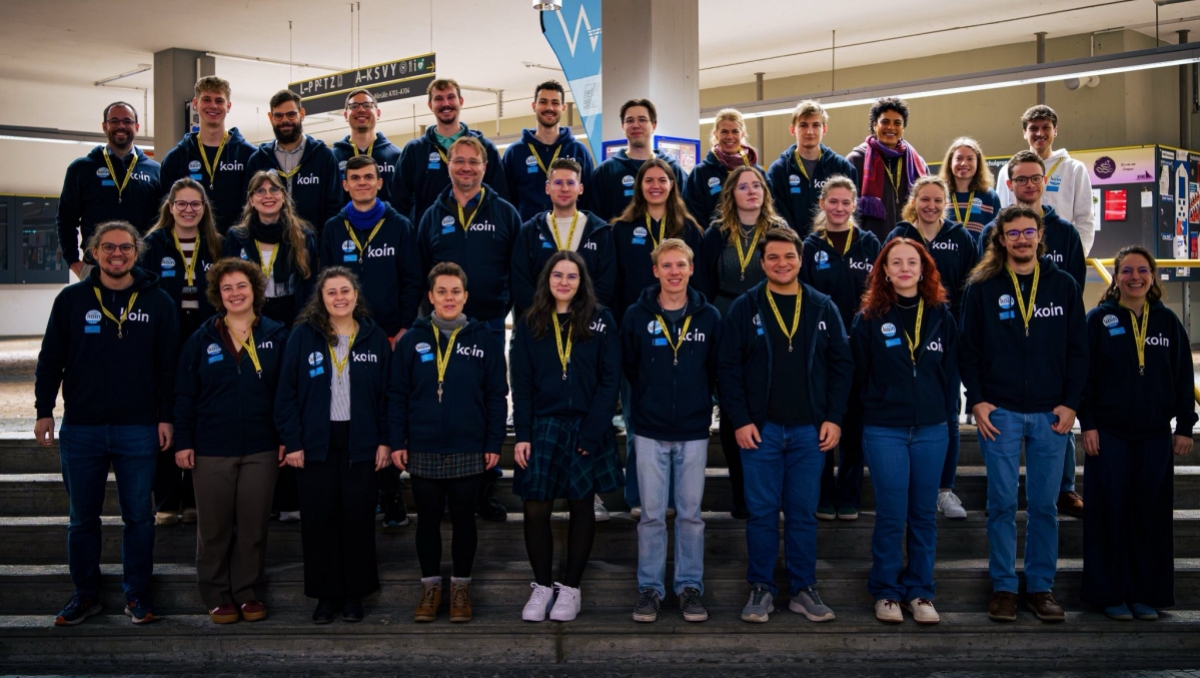 The computer science teacher training programme (KOIN) is supported by a great team.
"The KOIN programme is challenging for participants, and we really respect everyone who leaves their usual position in front of a class to return to the role of a student. This is something we also tell course participants that we are aware of."
Michael Grossniklaus, a professor of databases and information systems at the University of Konstanz
Depending on their affinity to the topic and previous knowledge and experience, the programme takes about 150 hours to complete. This additional work, however, is mostly balanced out by a reduction of teaching load amounting to two to three hours fewer in the classroom per week.
Individualization is part of the concept
"We realized that, in order for this type of programme to work well at scale, that is: with so many participants, we need to be able to customize it – in the best case, for each individual person. This is particularly important for computer science", says Grossniklaus. The KOIN programme has to account for different school types as well as the different levels of prior training participants have had.
"Here in Konstanz, our close coaching is what give us an edge over many other self-study programmes", emphasizes programme coordinator Blumenschein. "When participants don't turn in assignments, we contact them to find out why and look for individual solutions, if needed. We have a wide range of digital support services and moderate a very active forum where participants can connect with each other as well as our team." The student tutors make a particularly important contribution to providing individual advice and support, with an excellent ratio of about 20 participants per tutor. Many of the tutors are computer science education students, and all of them receive intensive training – not just on the subject matter, but also on how to work with the target group.
Back in the classroom
The programme's intensive coaching is one reason Pampel gives for the extremely low dropout rate (2%) and why surveys attest to a high rate of overall satisfaction (94%). Many respondents say that they feel well-prepared to teach computer science in schools. To top things off, the team conducts accompanying research on the programme, for example, on the factors that determine the success of blended learning formats.
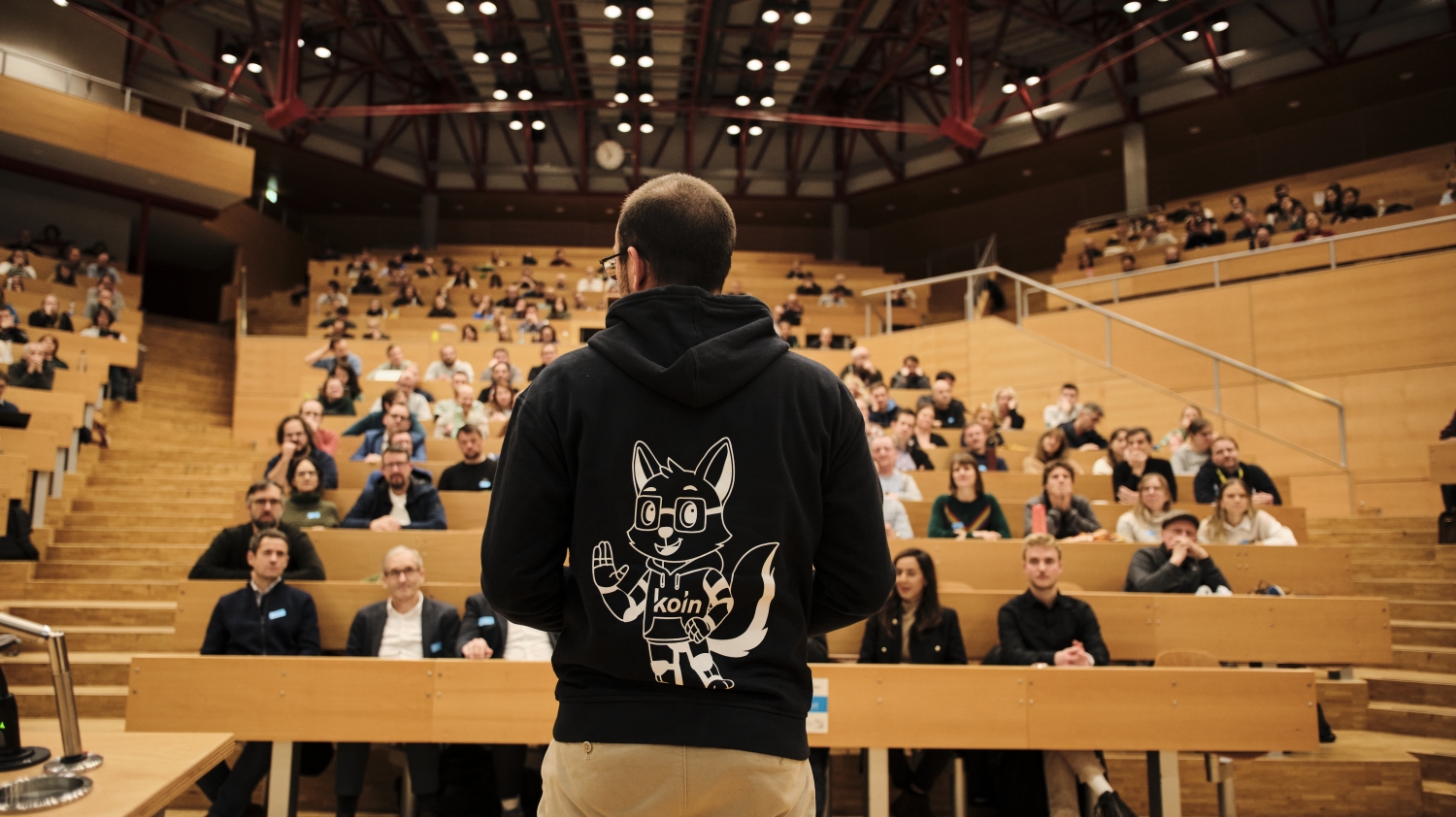
© Philipp UricherPrinted on the sweater: KONSTI, a chatbot developed by the University of Konstanz that specializes in the KOIN programme. From the beginning of the school year until mid-November, it was asked 2,000 questions already.
What advantage do school students have from programme? Pampel adds that students benefit from getting high-quality computer science education from teachers trained in the field, since teaching these classes is equally as challenging as any other science subject. It involves more than just media education and really dives into the computer science foundations of the system.
"Computer science forms the basis for many constantly changing media phenomena that today's school students navigate on a daily basis. For example, as they use AI tools, they hear over and over again that artificial intelligence does not always make correct statements. Yet, they can only understand why this is the case, when they know how the systems work." Pampel explains with an example: "In order to prevent school students from being taking advantage of every time they go shopping, we don't explain how to use a calculator app – we teach them to do the calculations themselves."
Barbara Pampel
The KOIN programme is a joint project of the Department of Computer and Information Science and the Academy of Advanced Studies (AWW) at the University of Konstanz, the Baden-Württemberg Ministry of Education, Youth and Sports and the state's Center for School Quality and Teacher Education (ZSL). Funding for the programme is provided by the last two institutions. The ZSL provides continuing education on teaching methodology and practices for those who have completed the programme. The KOIN programme is a continuing education post-qualification as defined in the Landeshochschulgesetz LHG (state law on higher education) in addition to being quality-controlled and Bologna-compatible. Ulrich Wacker, director of the AWW, highlights:
"We also designed KOIN as a micro-credential. This is in response to the comprehensively discussed impulse by the European Commission to enact compact and consistently digitally accessible continuing education formats and degrees."